Beauty Industry Business Software: Trends Shaping UK Salons in 2026
Explore beauty industry business software trends for 2026. Learn how UK salons can streamline bookings, payments, and client journeys without extra admin.

What if the most useful beauty software trend for 2026 is not another clever feature, but fewer gaps between the tools you already use? Beauty industry business software is moving towards more connected client journeys, bringing bookings, payments, reminders and client information closer together. If appointments are managed in one system, payments in another and client notes elsewhere, that can mean repeated admin. A new tool should solve a real problem, not add another layer of work.
It is understandable to be cautious about changing how clients book, especially when talk of automation and AI can make software sound more complicated than it needs to be. This article looks at practical changes for UK salons, clinics, barbers and solo professionals, and how to judge whether a feature suits your business. You will learn how to identify workflow gaps, what to check before choosing a system and how to take a manageable next step without disrupting a booking journey that already works.
Key Takeaways
- Beauty industry business software can connect parts of your workflow, but not every salon needs the same setup.
- Trace the client journey from checking availability to arriving for an appointment, and note where repeated admin or missing information causes friction.
- Use a simple workflow audit to identify what needs attention before comparing tools.
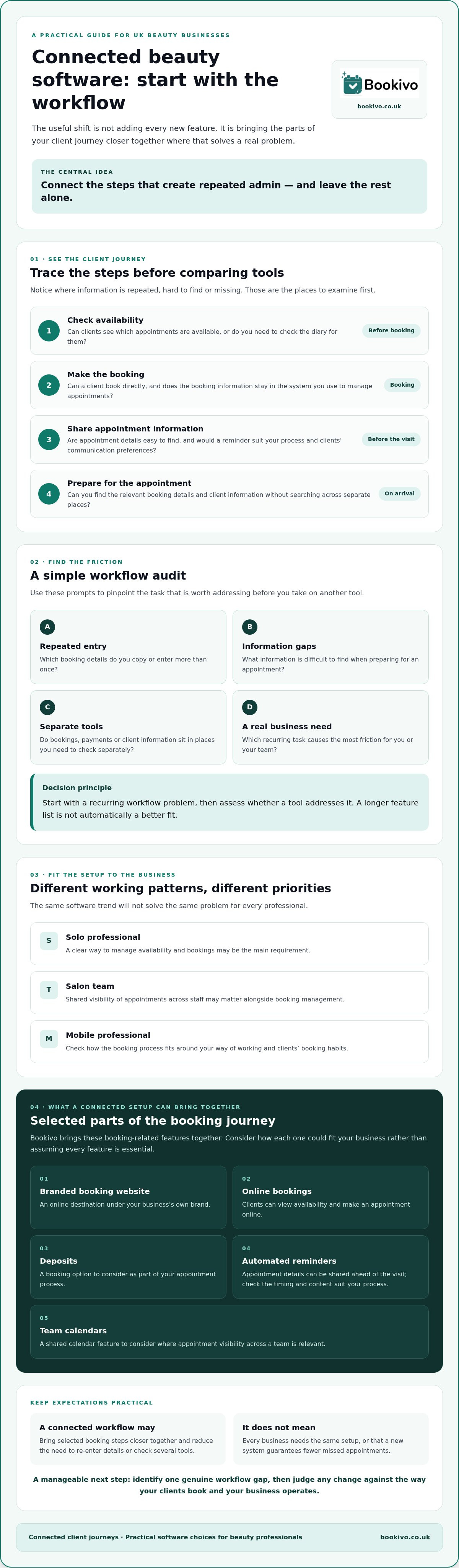
- Consider how a branded booking website, online bookings, deposits, reminders and team calendars could fit together in your business.
Table of Contents
Beauty industry business software in 2026: what is changing for UK professionals?
For UK beauty professionals, the practical shift is from paper diaries and separate apps towards digital workflows that connect selected parts of daily work. Rather than checking availability in one place, copying appointment details elsewhere and tracking follow-ups separately, businesses can look for ways to keep relevant information together. The aim is not to adopt every new tool. It is to make routine tasks easier to manage.
Beauty business software helps organise appointments, booking information and related client tasks. That is a useful starting point for salons, aesthetics clinics, barbers, mobile therapists and solo professionals. The wider cosmetics industry covers products as well as beauty services, but appointment-led businesses have specific operational needs that broad software descriptions can overlook.
From digital diary to connected business workflow
A digital diary can show when a client is booked. A more connected setup may also link the appointment to tasks such as managing client details or taking a deposit. For example, a therapist could let clients check availability and book online, then manage the appointment and its related details through the same system instead of entering them again elsewhere. This mirrors a broader shift across various industries towards unified systems, where platforms like Mooov demonstrate how centralising operations can reduce administrative friction. The value depends on which steps currently create extra work.
Why the same software trend affects businesses differently
A solo professional may mainly need a clear way to manage availability and bookings. A salon team may also need shared visibility of appointments across staff. A mobile therapist may have a different working pattern, so it is worth checking how bookings fit around it. Businesses exploring booking software for mobile beauty professionals can use that model to consider their own requirements.
There is no need to overhaul a working setup just because a trend is gaining attention. Start with the repeated task or information gap that causes the most friction, then assess whether a connected tool would address it. Look for a fit with your business model and clients’ booking habits, rather than a long list of features you will not use.
Connected client journeys: how booking, payments and records fit together
A client journey starts before they arrive. They check availability, book a service, receive appointment information and attend. If each step sits in a different place, you or your team may need to re-enter details or check several tools. A connected setup can bring selected steps together and reduce duplicated admin, although it cannot guarantee fewer missed appointments.
A branded booking website gives clients an online booking destination under the business’s own brand. They can use it to view availability and make an appointment, while the business manages bookings through its chosen system. The Value of Beauty 2026 report offers wider context on the UK sector, but the right digital workflow still depends on your services and clients.
Booking and communication in one client journey
Online availability lets clients see which appointments can be booked without first asking you to check the diary. An automated reminder can provide appointment details ahead of the visit, prompting clients to review their booking. Check that the reminder’s timing and content suit your process and the way your clients prefer to communicate. When comparing systems, ask whether clients can book directly and whether reminders are part of the same workflow. For practical guidance on managing appointments, readers can explore a digital salon diary or a guide to aesthetics clinic business tools.
Client information, forms and professional boundaries
Keeping booking details and relevant client information organised can make it easier to prepare for an appointment without searching across separate records. Digital consultation and consent forms can support the administrative process of collecting information. They do not replace professional judgement or specialist advice about clinical, treatment or regulatory matters. Businesses considering these forms can refer to a dedicated guide to electronic consultation forms for more detail.
Bookivo brings online bookings, deposits, automated reminders and team calendars together with a branded booking website. To see how that kind of booking journey could appear for your business, explore a branded booking website preview.
How to judge beauty software trends without adding unnecessary complexity
Start with a recurring workflow problem, then assess the tool. This keeps decisions about beauty industry business software grounded in the work you need to organise, rather than features that sound impressive but do not address a real need.
A simple workflow audit for salons, clinics and solo professionals
Map what happens from the first appointment request through to booking and follow-up. Write down where details are checked, copied or chased, and where a client has to take an extra step. A salon might find appointment information repeated across a diary and staff messages. A solo professional might spend time confirming availability manually. Mobile professionals can consider how bookings fit around their working pattern, with information about mobile beauty bookings as one relevant example.
- Repeated admin: Which task do you regularly do more than once? Note where the same details are entered or checked.
- Client friction: Where might a client have to wait for a reply or repeat information before booking?
- Duplicated records: Which details are stored in more than one place, and who needs to refer to them?
Questions to ask before changing systems
Check the fit before making a change. What do clients need to do to book? What must you or your team see to manage appointments? Which information needs to be organised, and who needs access to it? Then compare the system with your business size, service model and clients’ existing booking habits.
Automation is useful when it removes a repeated step without creating extra checks or confusing clients. If a feature adds work, depends on a process you do not use or makes booking less familiar, it may not be the right priority. You can assess one part of the workflow first instead of assuming a complete system change is necessary. Before expanding a tool’s role, check that it solves the problem, fits your routine and is straightforward for clients to use.
What a connected approach could look like for a beauty business
A connected setup does not mean every task must move into one system. It means choosing tools that make the parts of your booking journey easier to manage together. Bookivo is a UK booking and business management platform for beauty professionals. Whether it suits a particular salon or clinic depends on its workflow and requirements.
A branded booking website as a practical starting point
A branded booking website gives clients an online destination to book with your business under its own name and identity. This differs from relying on a marketplace listing to present your services. Bookivo includes a branded booking website, online bookings, deposits, automated reminders and team calendars. For a salon, those features could support a path from checking availability to making a booking, while staff manage appointments through team calendars.
Other features may suit particular workflows rather than every business. Consultation and consent forms, before-and-after photo storage and Customer CRM are worth considering if they address a specific need. Solo professionals can use this example for solo beauty professionals to assess what might fit their way of working. A guide to adding online booking to a salon website may also help with planning, but check that any guidance reflects your current website setup.
Explore the fit before deciding on a next step
Before choosing beauty industry business software, compare its booking journey with the one your clients already know. Bookivo offers a free branded preview, which lets you explore how a branded booking destination might look for your business. New users can also try the platform with a 7-day free trial, without a credit-card requirement. Compare the relevant features with your workflow, then decide whether to take it further.
Choose a practical next step for your business
The useful direction for beauty industry business software is a more connected client journey, not simply more features. Start by identifying where appointments, payments or client information become difficult to manage. Then check whether a tool fits your team, services and clients’ booking habits. A small, specific change may suit you better than replacing a setup that already works.
Bookivo is one option to explore, with a branded booking website, online bookings and deposits. A free branded preview and a 7-day free trial without a credit-card requirement give you two ways to assess whether the approach suits your business. You do not need to assume that every feature will be relevant.
Take your time, focus on the workflow that matters most and choose a next step that feels manageable for you and your clients.
Frequently Asked Questions
What is beauty industry business software?
Beauty industry business software helps salons, clinics and independent professionals organise tasks such as appointment booking, client communication and team availability. Some tools focus on a digital diary; others connect several parts of the booking journey. A salon, for example, might use online bookings and team calendars, while a solo professional may mainly need a clear way to manage availability and appointments.
How is beauty business software changing in 2026?
A practical shift is towards connecting online bookings with related tasks, rather than managing each step in a separate tool. Businesses may consider branded booking websites, automated reminders and organised client records. These are options to assess, not a prediction that every beauty professional needs the same setup. Check whether a feature addresses a recurring task and fits how your clients currently book.
Does a small beauty business need business management software?
Not necessarily. Start by identifying tasks that repeatedly take time or make booking harder for clients. A solo professional might prioritise online availability and appointment booking, while a salon team may need shared calendar management. Choose functions that address a genuine workflow issue and suit your business size and service model. There is no need to replace a system that works well without a clear reason.
What should beauty professionals check before using new booking software?
Map your current booking process, identify who needs access to information and note what clients must do to make an appointment. Then compare the software’s features with those tasks and ask the provider how it handles data. For privacy questions, consult authoritative UK guidance, such as the Information Commissioner’s Office. Choosing software alone does not make a business compliant, so check your responsibilities separately.
Can beauty business software manage appointments and client forms together?
Some platforms provide both appointment booking and digital forms, but features vary, so check what a specific system includes. Bookivo offers online bookings and digital consultation and consent forms. These forms can support the administrative process of collecting information; they do not replace professional judgement or make clinical, consent or regulatory decisions for a business. Consider whether forms belong in your workflow before adopting them.
Want to see how a branded booking website could work for your business? Request your free branded preview from Bookivo, or explore the free 7-day trial.