Paperless Consultation Forms for Salons: Practical UK Guide
Discover how paperless consultation forms for salons improve record-keeping, save appointment time for genuine client care, and organise UK salon operations.

What if moving consultations online gave you more room for a proper conversation, rather than less? Paperless consultation forms for salons can make client records easier to organise, but the aim isn’t to rush clients through a screen or replace your professional judgement. Paper files can be awkward to retrieve, and completing paperwork during an appointment can pull attention away from the person in your chair.
A considered switch can keep the personal conversation at the centre while making the record-keeping process more manageable. This guide explains what digital consultation forms are, how to plan a transition that suits your services and team, and what to think about when handling client information. You’ll also see how Bookivo’s digital consultation and consent forms sit alongside its Customer CRM and before-and-after photo storage. Digital tools can support a more organised process, but they don’t take responsibility for careful data handling away from your business.
Key Takeaways
- Paperless consultation forms for salons can help bring relevant client information into a more organised process.
- Plan when information is gathered and leave space in the appointment for professional judgement and conversation.
- Review existing questions with your team, keep what is relevant to your services and test the new process on a small scale.
- Bookivo brings digital consultation and consent forms together with Customer CRM and before-and-after photo storage.
What are paperless consultation forms for salons, and what problem do they solve?
Paperless consultation forms for salons are a digital way to collect and organise relevant client information. They can provide a clearer record to refer to when preparing for an appointment, without turning the consultation into a box-ticking exercise.
A digital consultation form is a record-keeping tool, not the consultation itself. It changes how information is captured and stored; it doesn’t decide what a service should ask, or replace a professional’s conversation with a client.
Where paper forms create friction in a busy salon
Paper records may work well for some teams. In others, a form might be filed in the wrong place, take time to locate or be difficult to review before a client arrives. These small interruptions can add friction to appointment preparation, particularly when records are kept in different places. For teams that want to convert physical paperwork into clear digital PDFs directly from a smartphone, read more.
There’s also the moment of completion. If a client fills in a form during the visit, writing answers and discussing them can compete for the same time. A digital process may help separate information gathering from the in-person conversation, depending on how the salon chooses to use it.
What paperless does, and doesn’t, mean
Moving a form onto a screen doesn’t make its questions suitable by default. Review what information is relevant to the service and the salon’s process, rather than simply copying every question from an old template. The wider idea of digital transformation is about changing how work is done, not just changing the format of a document.
A digital record can support preparation, but it can’t make decisions for the professional. The conversation still matters: it gives the client a chance to explain their answers and the professional space to use their judgement. Consent responsibilities remain with the business and the relevant professional, whichever format the form uses.
How do digital consultation forms fit into a salon appointment?
A useful process has three parts: preparation, the in-person conversation and consistent record keeping. The form can gather relevant information, but the professional still needs to interpret it in context and speak with the client. Digital forms support appointment preparation, but they can’t replace a professional consultation.
Before and during the appointment
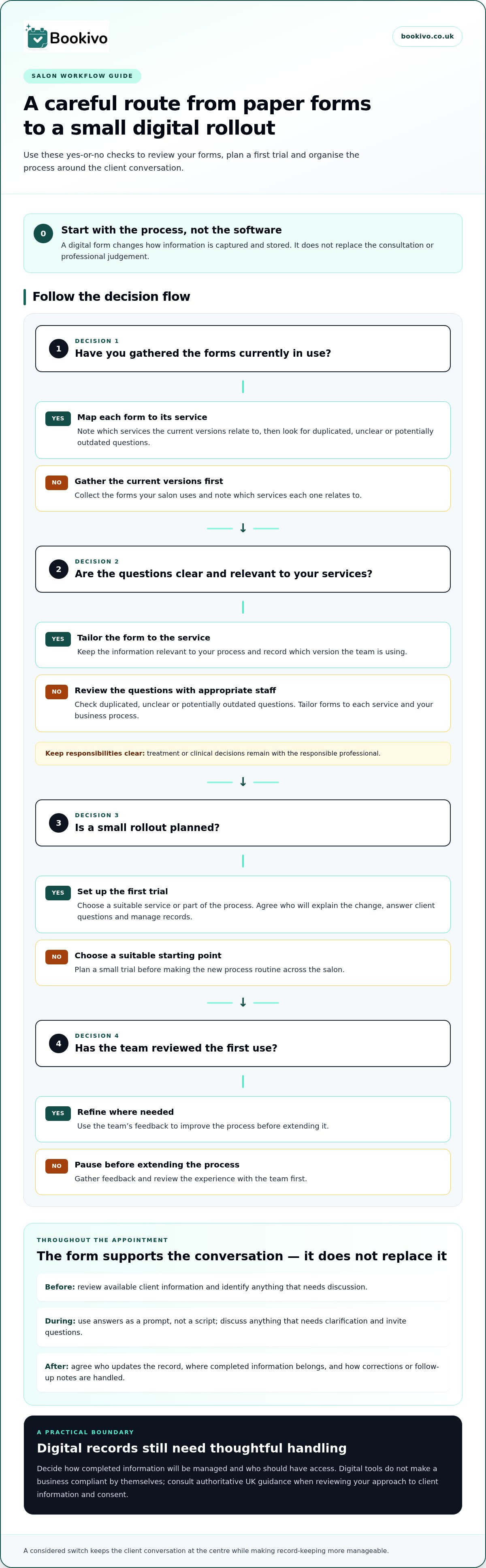
Before a visit, a team member may review the client information already available and identify anything that needs discussion. This doesn’t depend on assuming forms are sent automatically: a salon can decide how and when clients complete them as part of its own process.
During the appointment, use the answers as a prompt, not a script. For example, if a client’s response needs clarification, take time to discuss it and invite questions. Keep routine information gathering separate from decisions made by the professional during the visit. Each service may call for different questions, so tailor forms to the service and the way your business works.
After the consultation: keeping records organised
Agree a consistent approach for filing or updating each client’s record after the conversation. Decide who is responsible, where completed information belongs and how the team will handle corrections or follow-up notes. A digital format can support that process, but organisation still depends on clear routines and staff using them consistently.
Client information should also be handled thoughtfully. For general considerations, see this guide to data protection for salons, and consult authoritative UK guidance when reviewing your own approach. A form or platform isn’t a substitute for the business’s responsibilities around client information and consent.
As you plan the workflow, consider how forms might sit alongside your wider salon booking and management setup. The aim is a useful record and a prepared conversation, with the client still at the centre of the appointment.
How can a salon switch to paperless consultation forms?
A steady transition starts with the form and the salon’s process, not with a software decision. Treat paperless consultation forms for salons as a change to how your team gathers and manages information. A staged approach gives staff time to spot practical issues before the new process becomes routine.
- Review the forms you already use. Gather current versions and note which services they relate to. Look for duplicated, unclear or potentially outdated questions.
- Decide what remains relevant. Review questions with the appropriate staff and tailor them to each service and your business process. Keep treatment or clinical decisions with the responsible professional.
- Plan a small rollout. Choose a suitable service or part of the process to try first. Agree who will explain the change, answer client questions and manage records, then review the experience with the team before extending it.
Review and organise forms before digitising
Don’t transfer every question simply because it appears on an existing form. Ask whether it’s still clear and relevant, and whether different services need distinct forms. The right staff can help assess the questions; decisions about treatment and clinical matters should remain with the responsible professional. Keep a record of which version the team is using.
Introduce the change consistently
Agree a simple explanation for clients so the team can describe what the form is for and respond calmly if someone has a question. Set out how completed information will be managed, who should have access, and what staff should do if a record needs attention. After the initial use, gather feedback and refine the process where needed.
Digital tools don’t make a business compliant by themselves. Review the Information Commissioner’s Office (ICO) guidance for organisations when considering how your salon handles personal information. Make access and record-management decisions as part of your own procedures, rather than assuming the format settles them.
How Bookivo supports digital consultation forms for salons
Bookivo is a UK booking and business-management platform for beauty businesses. It includes digital consultation and consent forms, alongside Customer CRM and before-and-after photo storage. For salons considering paperless consultation forms for salons, these confirmed features offer a way to explore digital forms within a broader business platform, rather than treating consultation paperwork as a separate task.
Bring consultation forms into a broader business workflow
Forms are one part of the process. A salon can consider how they fit alongside its booking and client-management arrangements, while keeping its own approach to reviewing information and speaking with clients. Bookivo’s Customer CRM and before-and-after photo storage provide additional client-management capabilities, but the salon remains responsible for deciding how its team uses information and handles consultations.
Bookivo doesn’t replace staff judgement or the conversation with a client. Nor should you assume a particular form workflow: focus on whether the available features suit the process you’ve planned. Explore the beauty business booking and management software to see how the broader platform is presented, and review Bookivo pricing information when comparing options for your business.
Choose a low-pressure next step
If you’re still deciding how a digital process could fit your salon, start by viewing the branded preview. It can help you consider the platform in the context of your business before choosing whether to explore further.
A 7-day free trial is also available without a credit-card requirement if you’d prefer to explore the platform directly.
Make your next step a considered one
Paperless consultation forms for salons work best when they reflect the way your business wants clients to feel: listened to, informed and treated as individuals. As you consider your next move, focus on the experience you want to create, not simply on replacing a sheet of paper with a screen. A useful digital process should fit around the service and leave room for the professional conversation.
Think about what would make the process clearer for your clients and your team. Then explore options with those priorities in mind. You can take a closer look at Bookivo’s presentation for beauty businesses and decide whether it feels like a natural fit for the way you want to work.
See what Bookivo could look like for your business.
Take the transition at a pace that suits your salon. A thoughtful change can help you build a more organised process while keeping people, not paperwork, at the heart of each appointment.
Frequently Asked Questions
Can paperless consultation forms replace an in-person salon consultation?
No. Paperless consultation forms for salons can gather information, but they can’t respond to a client’s uncertainty or explore what an answer means in context. If a client is unsure how to answer a question, the professional can clarify it during the appointment. Use the form as a starting point for discussion, not as a substitute for the professional’s assessment and conversation.
What should a salon consider before switching to digital consultation forms?
Map how a form will be completed, reviewed and followed up, then consider what happens if a client can’t or prefers not to use the digital option. Think about which team members need access, how staff will handle questions and how existing records fit into the change. A small trial with one service can help reveal practical snags before the salon expands the process.
Are digital consultation forms automatically GDPR compliant?
No. Using a digital form or software doesn’t, on its own, establish that a salon is meeting its data protection responsibilities. The business should consider what information it collects, how it is handled and who can access it. For guidance relevant to UK organisations, consult the Information Commissioner’s Office (ICO). Seek appropriate advice if you need help interpreting your responsibilities.
Can different salon services use different consultation forms?
Yes. Separate forms may be useful when the information relevant to one service differs from another. For example, a salon could distinguish between forms for hair and nail appointments, rather than presenting every client with questions that don’t relate to their booking. Keep the titles clear and ask the appropriate staff to review each version so the team can identify which form is relevant.
How can a salon keep digital client records organised?
Set a consistent routine for identifying records, updating information and managing older versions of forms. Decide who is responsible for each task, and review access periodically as team roles change. Keep the process simple enough for staff to follow during a busy day. Clear internal steps matter: digital storage alone won’t decide how the salon maintains or checks its records.